
We All Change
The other day I was telling one of our sons that he could never know his parents because he met the responsible pay-the-bills, save-for-the-future, teach-your-children-well version of us. And yet at our core, we identified with the turbulent ‘60s when we were finding our way through high school and college. The Age of Aquarius and the Beatles, multiple assassinations, miniskirts, the draft lottery, hippies, Vietnam. When I listen to the music of that decade, it takes me back to a tumultuous, yet glorious, time in my life.
On the flip side, I don’t think I can truly know my sons as adults. This thought is based on anecdotal reasoning.
- When Jim was a kid, he loved those marshmallow Peeps. In his adult years, his good-intentioned mom would bring him Peeps each Easter. He never told her he’d outgrown that sugary treat. A few days after Easter Sunday, we’d toss them in the trash.
- I was working in Denver, when one Sunday evening my folks called. This was a time when long distance cost so much a minute, so we usually communicated by letter. The Wizard of Oz was on TV, and they wanted to be sure I knew it. I had loved that movie as a kid and watched it each time it was on. It didn’t have the same appeal when I was 24, but I thanked them profusely for calling to let me know. After I hung up the receiver, I did not turn on my used 15-inch black-and-white rabbit-eared set.
- My friend Virginia’s husband always carved a jack-o’-lantern with his daughter, a tradition he believed she valued as much as he did. They were planning a three-hour drive to her college one October weekend, and he was packing a pumpkin and two carving knives when Virginia finally convinced him that maybe they could just paint a face on the pumpkin and avoid pumpkin guts and seeds in their daughter’s dorm room. I know for certain the daughter was thankful for her intervention.
- My friend Ralph told me that he and his wife routinely attended their grandchildren’s sporting events. They carried lawn chairs and would sit with their son and daughter-in-law and their friends. One evening they were running late, walked up behind the group, and his son was talking and laughing with his friends and was more animated and quite a different person. “Of course, he was, “I said. “Didn’t you act differently when your folks were around?” We want to live up to our parents’ expectations. We can’t just be relaxed and be ourselves. I loved my parents dearly, but I felt freer to express myself when they weren’t around at an event.
My point is—people change with time. And yet, some parents see their children as they were when they lived at home and were a family with lots of noise, always hungry mouths, and needing rides to here and there. Adult sons and daughters see their parents as just that—parents. I’m sure to my sons, I’ve always been old. My parents were always old to me, and yet my mom was in her 40s when I got married. How young that seems now.
Of course, I wish I could ask my folks lots of questions about their youth, and maybe I should tell my boys who I was in my teens and 20s.
Hmmm. Maybe not.
Hot off the press! Get In Line
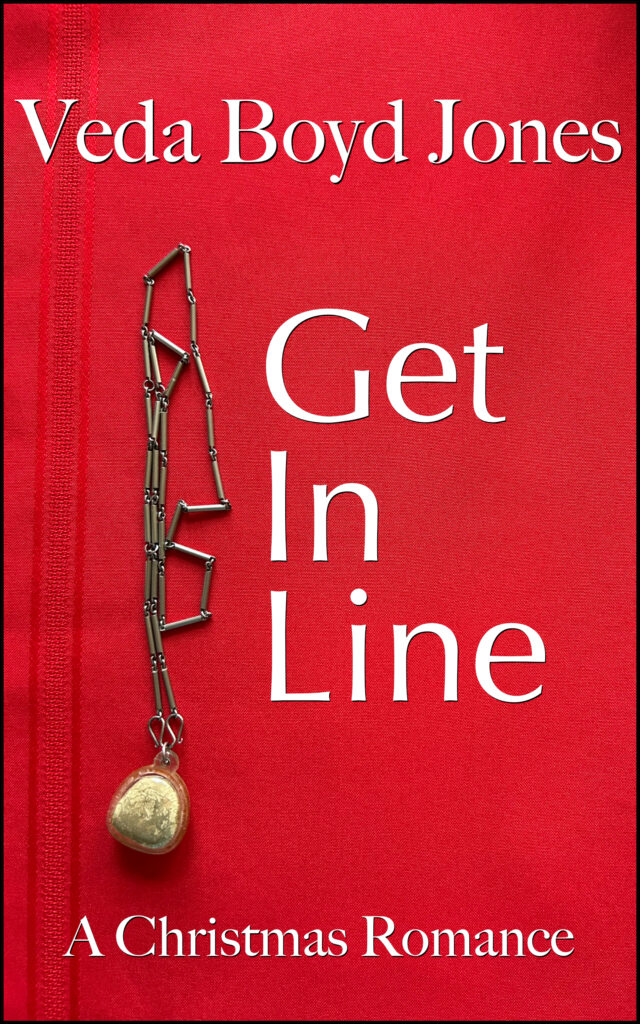
Pro golfer Carter Fox quit the tour for personal reasons and is now the golf coach at Missouri State. The tour was his dream job, but coaching is a close second. When during semester break he’s at a family Christmas gathering, his grandmother’s necklace is dropped accidently into Table Rock Lake at Holiday Island, Arkansas. He immediately calls a recovery diving service to retrieve the keepsake.
The practical Carter doesn’t believe in love-at-first-sight, but he is unprepared for the instant connection he feels with attractive Edie Monroe, the fearless owner of E-M Divers.
He asks one of her crew members if she’s single. His reply, “For now. Get in line.”
Whatever it takes, Carter is determined to show Edie that he deserves to be at the front of the line.
Other Kindle Christmas books by Veda Boyd Jones:
- The Sheriff’s Christmas Candy
- The Bookstore Window
- An Ozark Christmas Angel
- The Best Christmas Gift Ever
- Ashley’s Christmas List
- The Cowboy’s Christmas Secret
- The Ranger’s Christmas Treasure
- The Cowboy’s Christmas Getaway
- Here’s Your Trouble: A Christmas Story
- The Christmas Parade
- On One Condition
- The Bachelor Association
- The So-Called Never-Fail No-Risk Plan
The Bookstore on Main: Book Five of the Lost Creek Novel Series
 Women Helping Women
Life is never dull in Lost Creek, Arkansas. Olivia Jenkins, transplanted New Yorker, continues to adapt to change living in a small town. And big changes are coming. Three-time Oscar winner Ellie West (Ruby as Olivia knows her) is getting married in the renovated theater with the reception in the basement (the 1920s hidden speakeasy). Anna is opening her quilting store, and Marie’s law practice is flourishing. But what about Olivia? She’s busy, but is staying busy the same thing as having purpose?
Every day brings irritants, joy, monotony, excitement and deep personal growth for the band of four women and the connections that shape their lives. Oh, and for the men who love them.
Fans of Jan Karon’s Mitford series will enjoy the Lost Creek Novels, a contemporary look at life and friendships in a small town. Download your copy today!
- Book One: The West End of Main
- Book Two: 309 Main Street
- Book Three: One Block Down Main
- Book Four: The Alley South of Main
- Book Five: The Bookstore on Main
s(pace
2026 essays
- October: We All Change
- September: TV Sitcom Mentors
- August: Making the Bed
- July: Garbage In
- June: No, I’m Not Dead Yet
- May: Mishaps and Mysteries on the “Take It Easy” Tour
- April: Small Things
- March: Kind Strangers
- February: Risky Behavior
- January: Learning from 2025
2025 essays
- December: I’ll Decide for Me
- November: The Flyovers
- October: I Do It For Me
- September: Anam Cara
- August: The Earl of Sandwich
- July: Tinker to Evers to Chance
- June: Hidden Memories
- May: One of My Many Humiliating Moments or Is Honesty the Best Policy?
- April: Unfashionable
- March: Relying on Kindness
- February: I Procrastinated
- January: The Culprit
2024 essays
- December: A Christmas Gift for You
- November: Handbags and Crystals
- October: Kristofferson, The Poet
- September: The Hamburger Stand on Main Street
- August: Aunt Punch
- July: My Unpublished Letter
- June: The Last One
- May: Me? A Swiftie?
- April: My Old Job
- March: Her Silver Service
- February: From Start to Not Yet Finished
- January: Tossing Old Spices
2023 essays:
- December: What I’ve Learned So Far
- November: Indecision
- October: Esprit D’escalier
- September: Hearing the Birds
- August: Happiness is a Perfume
- July: Keep Smiling
- June: Spring Rituals
- May: I’ll Hitch a Ride
- April: The Jonquils
- March: Live in the Moment?
- February: Signs
- January: Resolution: Less Whining
2022 essays:
- December: Dorian Gray
- November: Ozark Seasons
- October: The So-Called Never-Fail No-Risk Plan
- September: An Unwelcome Souvenir
- August: The Gate to Nowhere
- July: The Land Line
- June: Don’t Call Me
- May: Who’s To Judge?
- April: Time Changes
- March: The Queen of England
- February: A Bit of Chaos
- January: Headlines!
2021 essays:
- December: The Junk Drawer
- November: Keep Your Fork
- October: Write Your Life
- September: Sleeping on the Floor
- August: Life on the Mississippi or What I Learned on My Summer Vacation
- July: Jerry Stamm
- June: A Trying Time or Replacing the Mattress
- May: The Pace
- April: Learning From a Past Mistake
- March: Attitude Change Needed
- February: I Am an Eagle
- January: What Next?
2020 essays:
- December: Old Ornaments
- November: Period.
- October: On One Condition
- September: Capturing Sunshine
- August: Baseball’s Return
- July: They Bug Me
- June: Coincidence or Mysterious Connection?
- May: Spontaneity
- April: The Paints on the Wall
- March: The Signature Sandwich
- February: The Dream Catcher
- January: A Random Act of Kindness
2019 essays:
- December: Raking the Leaves
- November: Reflections in the Mirror
- October: Pioneer Woman
- September: Rewinding
- August: The Last One
- July: Nice People
- June: Jeopardy
- May: Playing
- April: Seeing the World
- March: The Signature
- February: So I Went
- January: NOW do it
2018 essays:
- December: Eureka!
- November: Morning Ritual
- October: The Hard Part
- September: Walking in the Dark
- August: Old is New Again
- July: Change Orders
- June: Country Songs
- May: Scars
- April: This Old Place
- March: Wearing a Robe
- February: A New Adventure
- January: Another Year
2017 essays:
- December: Beginning a Hiatus
- November: A Name
- October: Of Course, I’ll Use the Grand Canyon or How I Spent My Summer Vacation
- September: I Packed Courage, Too
- August: Nothing Dangles From My Rearview Mirror
- July: Grandma Brown’s Desk
- June: Old Paint
- May: Dandelion Yellow
- April: Cleaning Out Our Past
- March: The Flames of Cheer
- February: The Color of Oklahoma
- January: Former Cars
2016 essays:
- December: The Stocking Conundrum
- November: Comfort from a Cup of Tea
- October: A Friendly Wave
- September: Why Are First Memories Bad Ones?
- August: How to Treat a New Widow
- July: My Outrage or A Warning to Women
- June: Rock Collections
- May: May Baskets
- April: Screen Doors
- March: Hiraeth
- February: My New Key
- January: My Book Clubs
2015 essays:
- December: The Real Santa
- November: Mrs. Coker’s Lamp
- October: Life’s A Holiday
- September: School Reunions, a.k.a. Looking Forward to the Past
- August: Risk
- July: Old Shoes
- June: The Ant Invasion
- May: Goodbye to the Sailboat
- April: A Rant
- March: Sharing Joy
- February: On Reading Aloud
- January: The Lesson of Chicken Pot Pie
2014 essays:
- December: The Scent of Christmas
- November: Life Markers
- October: Forgiving Myself
- September: I Won’t Change It
- August: Back in Time and Looking Forward
- July: Changes
- June: The Napkin Controversy
- May: On Being Overwhelmed
- April: A Time for Everything
- March: Washing the Car
- February: Drowning
- January: Who Will Live in My House?
2013 essays:
- December: The Recipe on the Refrigerator
- November: The Lean
-
October: Washing Windows
-
September: Memories of Music
-
August: Leap Before You Look
-
May: The Hidden Garden
-
April: The Day Before April
-
March: My Favorite
-
February: The Safety Net
-
January: The Friendship House
2012 essays:
- December: Do I Have a Small Mind?
- November: The Wonders Around Us
- October: Gaining Knowledge
- September: Respecting Others’ Beliefs

